It’s Monday morning. I’m sitting at my desk, trying to find a comfortable angle for my left leg. Every time I stand up to grab https://www.pieandbovril.com/general/the-physical-reality-of-scottish-football-what-happens-after-the-final-whistle a coffee, there’s that familiar, sickening tug in the back of my thigh. It’s not a full-blown tear. It’s just that constant, nagging reminder of the 75th minute on Saturday. The ball was drifting behind the fullback, I opened up my stride, and— ping. Not a pop. Just a sudden, sharp tightening that forced me to jog the rest of the game like a pensioner chasing a bus.
If you play the game—proper football, not the pristine stuff on the telly—you know this feeling. You aren't playing in a stadium with a full-time medical staff. You’re playing on a pitch that’s half mud, half frozen grit, and your physio is usually a guy named Davie who doubles as the kit man and has a magic sponge from 1994.
We need to talk about why that hamstring keeps going, and why "toughing it out" is the fastest way to turn a six-week injury into a career-ending nuisance.
The Myth of "Just Running It Off"
You’ll hear it from the sidelines. "Leave it on the pitch, son!" or "Get stuck in, it’s just a knock!" It’s empty toughness talk. It doesn't help your general recovery, and it certainly doesn't fix the biomechanics of your sprint.
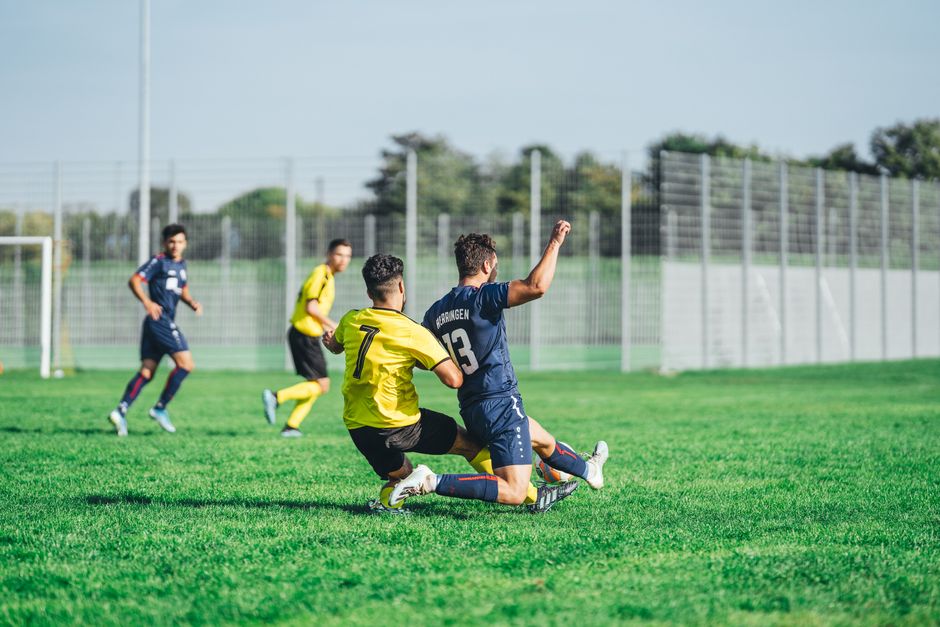
Ignoring pain isn't strength. It’s just poor management. When your hamstring tightens the second you hit top gear, it’s not because you aren’t "hard" enough. It’s because your body has hit a limit, and it’s screaming at you to stop before something catastrophic happens.
According to experts at the Cleveland Clinic, hamstring strains are common, but recurrent ones usually indicate that the initial injury wasn't fully rehabilitated or that the muscle architecture has been compromised by cumulative strain. You don't need fancy jargon to understand that. You need to understand that your muscle has been stretched beyond its capacity, and it has laid down scar tissue that isn't as elastic as the original fiber.
The Reality of Part-Time Recovery
Let's be clear: we don't have the resources of the Premiership. I worked a nine-to-five in insurance while playing in the lower leagues. My recovery process was a bag of frozen peas wrapped in a tea towel and a hot bath. That’s it.
When you have to go to work on Monday, your hamstring doesn't get the specialized soft-tissue work a pro gets. You sit in a chair for eight hours. That static posture is the enemy. It turns your posterior chain into a stiff, unresponsive cable. By the time you get to training on Tuesday, you’re already behind the curve.
Cumulative Strain and Unforgiving Surfaces
It’s not just the sprints. It’s the surfaces. Have you ever tried to plant your foot on a pitch that’s essentially a sandpit masquerading as grass? That’s where the damage starts.
Factor Impact on Hamstring Frozen/Hard Pitches Increased impact force; muscle needs to over-contract to stabilize. Heavy Mud High resistance; forces the muscle to work harder to generate force. Sedentary Day Job Reduced blood flow; tight hip flexors pulling on the pelvis.When you're playing twice a week on pitches that haven't been maintained since the last decade, you aren't just playing football. You're fighting the ground. Every time your foot hits the deck, your hamstring has to absorb that shock. If you haven't put in the strength rehab, that shock is going to turn into a tear.
Sprint Mechanics: Why Speed is a Danger Zone
The hamstring is most vulnerable during the terminal swing phase of a sprint—that moment right before your foot hits the ground. Your muscle is lengthening while trying to generate force to decelerate the lower leg. It’s a violent movement.
If your mechanics are off, or if your glutes aren't firing, the hamstring picks up the slack. When you try to sprint, you're asking a tired, compromised muscle to handle a massive load. It says "no." That "tightening" you feel? That’s the muscle’s way of protecting itself from snapping completely.
Three Steps to Manage Recurrence
Don't just stretch it. Stretching a tight, injured muscle is often the worst thing you can do. You’re pulling on fibers that are already inflamed. Instead, focus on these areas:
Eccentric Strength: You need to train the muscle to handle force while lengthening. Think Nordic curls or slow, controlled Romanian deadlifts. Pelvic Alignment: If your job keeps you sitting all day, your hip flexors are likely tight. This tilts your pelvis forward, constantly putting your hamstrings on a stretch even when you’re standing still. Loosen the hips. Progression: Stop jumping straight back into full-tilt sprints. Build your sprint mechanics back up in controlled environments. Start at 60% intensity and add 10% each session.Final Thoughts: The Long Game
I remember a game at Cowdenbeath in the wind and rain. The pitch was a disgrace. I felt my hammy tighten in the first five minutes. I spent the next eighty minutes compensating. I survived the match, but I could barely walk to my car afterward.
Was it worth it? No. It kept me out for a month, missed a big cup tie, and I still have a knot in that muscle three years later.
Stop pretending you’re invincible. Stop listening to the "toughness" rhetoric from people who aren't the ones feeling the ache on a Monday morning. Respect the injury. Build the strength. If you sprint and it tightens, stop. It’s not a test of character. It’s a warning.
Treat your body like the tools of your trade, because in our game, that’s all you’ve got.